Beyond models: Agentic AI architecture is here
December 8, 2025
How the new ‘million step with zero errors’ LLM system radically shifts the design of AI pipelines and what this means for multisensor, agentic systems in healthcare and enterprises.
1. Introduction
What if an AI system could execute one million linked steps without a single mistake?
That's the question answered by Cognizant AI Lab's recent MAKER paper (November 2025), another milestone that forces us to rethink how AI systems should be built.
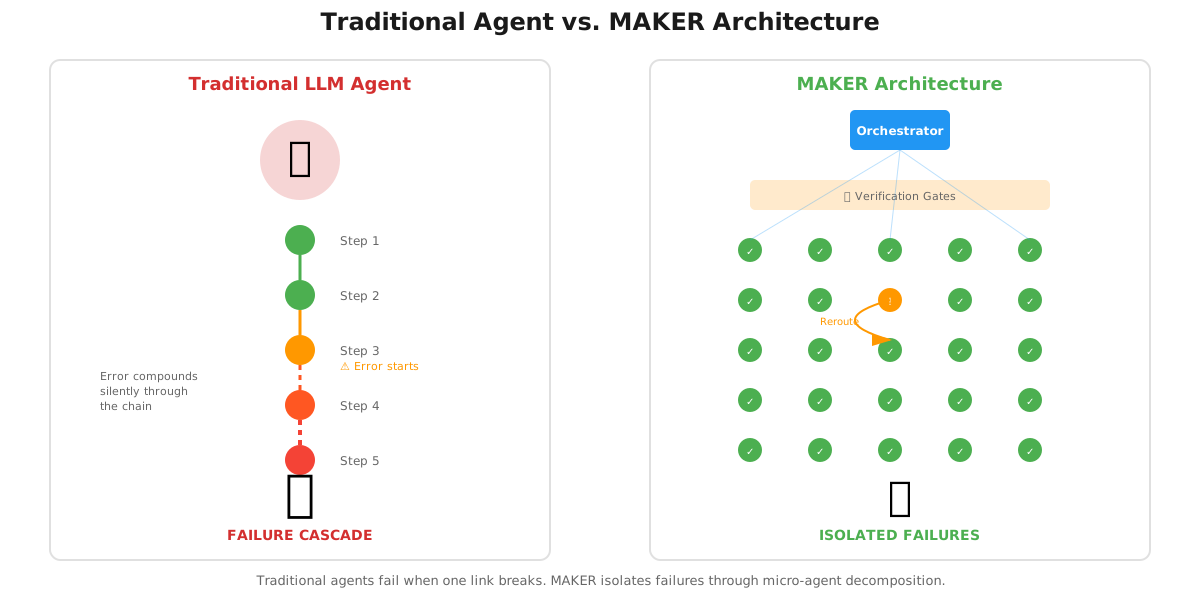
This paper challenges the most persistent myth in AI: that reliability comes from bigger models and longer context windows. MAKER shows that reliability comes from architecture, not scale. Not one big brain, but many small ones.
2. What the paper actually did
The problem: LLMs fail on long-range tasks
LLMs can produce brilliant results with single prompts, but they collapse when reasoning needs to stretch across dozens, hundreds, or thousands of steps.
The reasons are structural:
- The context window is a sliding buffer, not memory.
- Earlier decisions are lost or distorted.
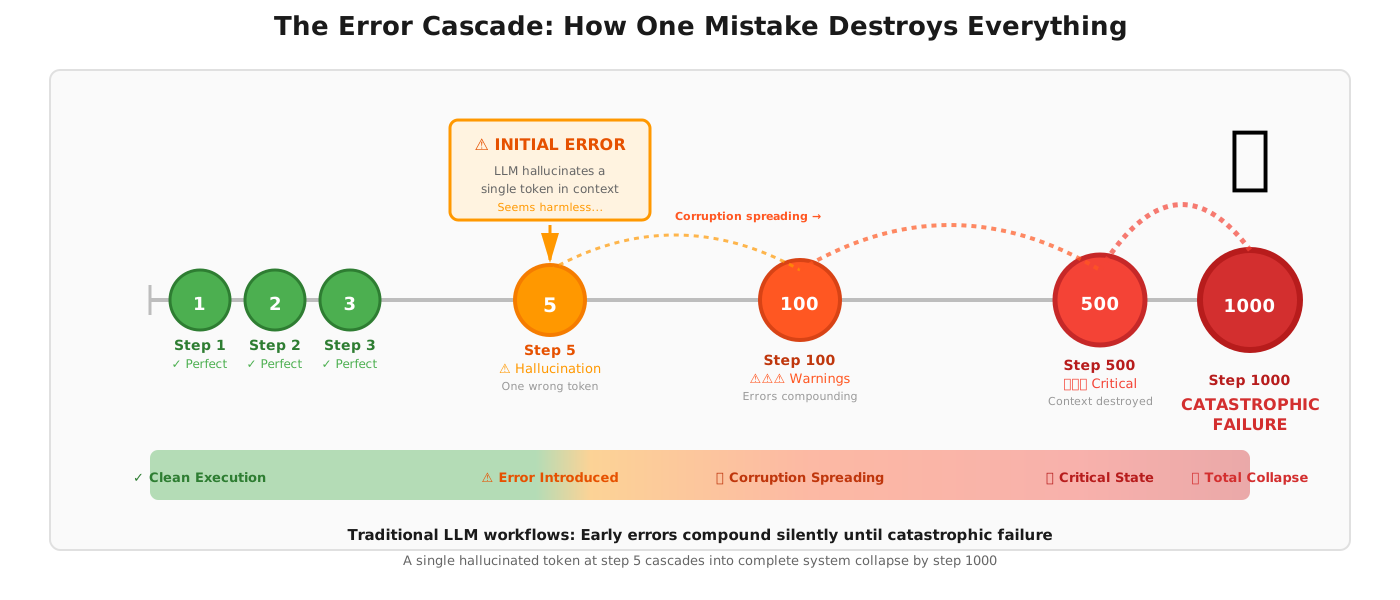
- Errors compound silently over time.
- One hallucinated token can derail the entire pipeline.
This makes long workflows like vibe coding, code execution, research, planning, robotics, or sensor pipelines nearly impossible to run through a single agent.
 The solution: MAKER's micro-agent decomposition
MAKER (Maximal Agentic decomposition, K-threshold Error mitigation, and Red-flagging) flips the script. Instead of using one powerful agent, MAKER uses extreme decomposition into small, verifiable subtasks executed by specialized worker processes, functionally similar to micro-agents, each with an extremely narrow responsibility and a near-zero chance of error.
It combines three core mechanisms:
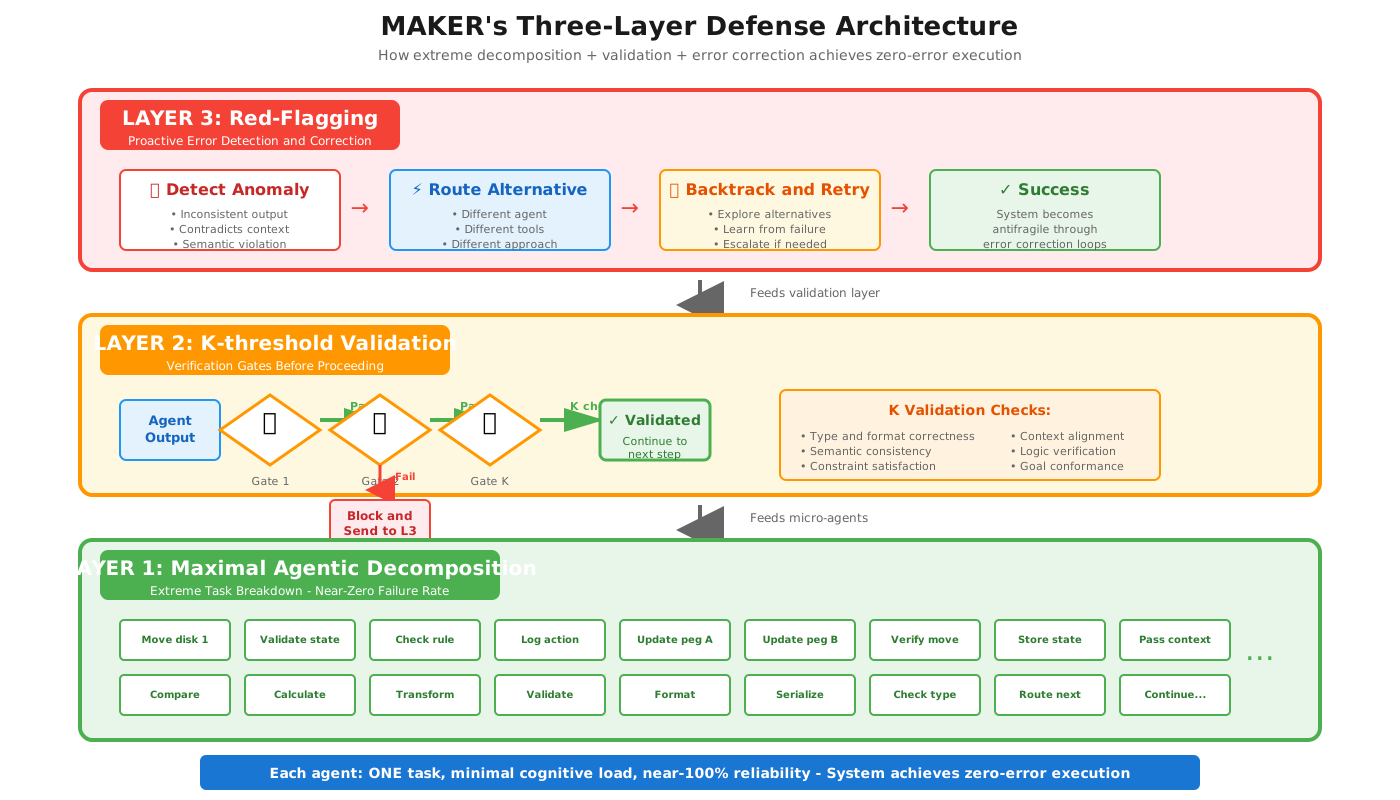
1. Maximal agentic decomposition (the "MA" in MAKER)
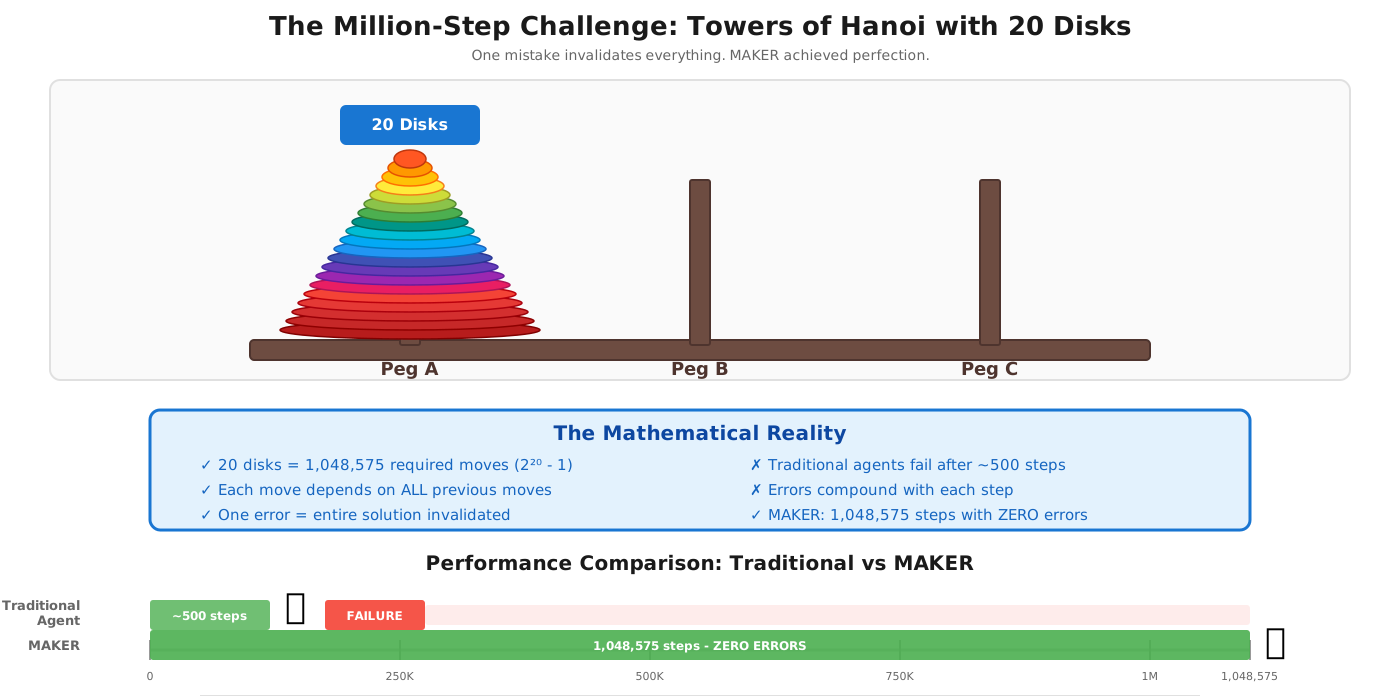
Every complex task is broken down into the smallest possible subtasks. Instead of asking an agent to "solve the Towers of Hanoi puzzle," MAKER decomposes this into 1,048,575 individual micro-decisions: "move disk 1 from peg A to peg B." Each agent has one job, executes it, and hands off to the next. This extreme decomposition means each agent operates at near-100% reliability because its cognitive load is minimal.
2. K-threshold Error Mitigation (the "KE" in MAKER)
MAKER validates all steps. After each micro-task, the system checks whether the output meets expected criteria. If K validation checks pass, the system proceeds. If they fail, it stops, flags the issue, and triggers correction. This creates a verification net that catches errors before they propagate.
3. Red-Flagging (the "R" in MAKER)
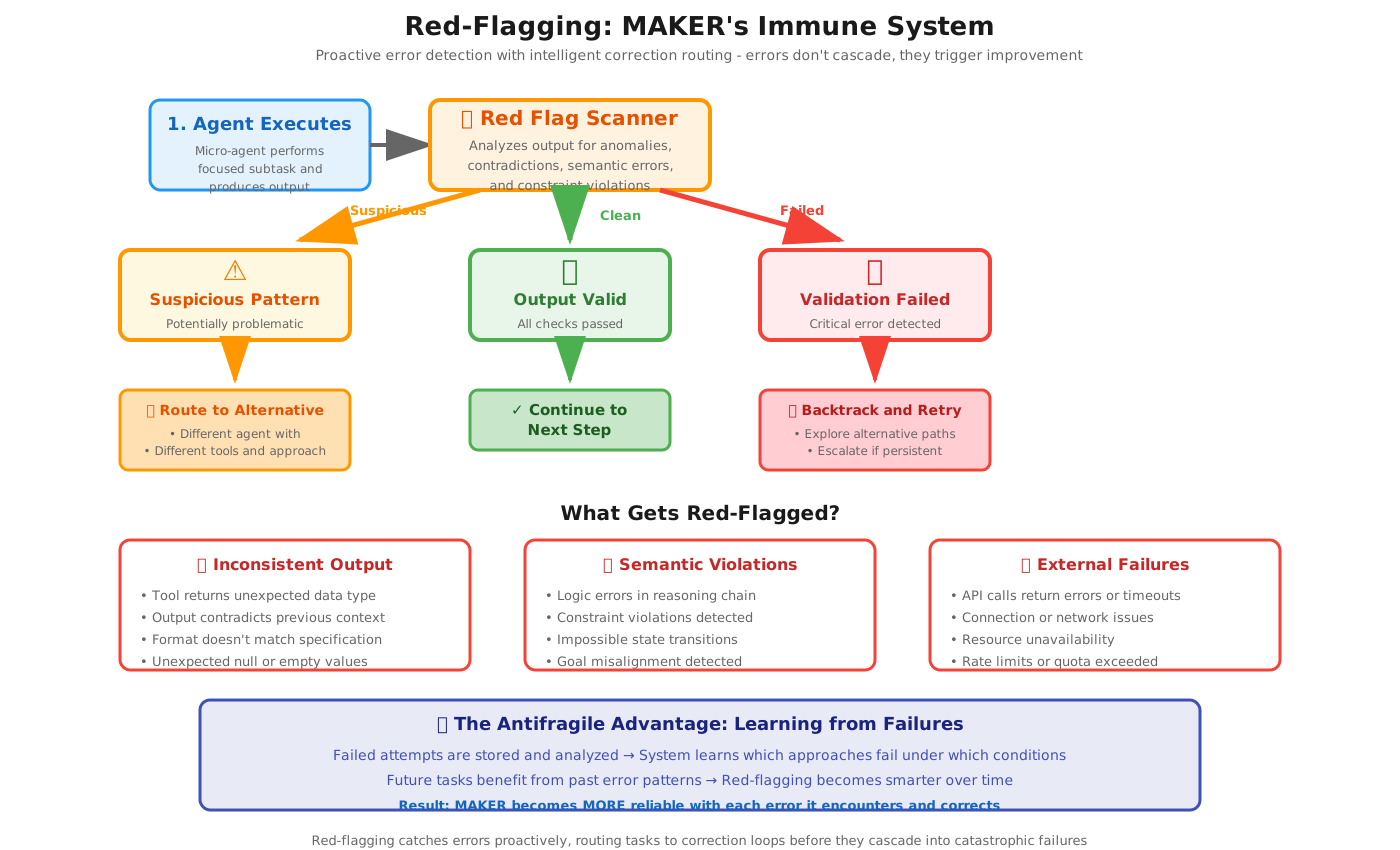
This is MAKER's immune system. When an agent produces output that seems inconsistent, contradictory, or potentially erroneous, the system raises a red flag. Unlike traditional error handling that waits for catastrophic failure, red-flagging is proactive. It identifies suspicious patterns early. For example, a tool call that returns unexpected data, a reasoning step that contradicts previous context, or an output that fails semantic checks.
When a red flag is raised, MAKER doesn't just retry the same approach. It can:
- Route the task to a different agent with alternative tools
- Request additional context or verification
- Escalate to a higher-level orchestrator for human review
- Backtrack and explore alternative solution paths
This makes MAKER antifragile: errors don't cascade, they trigger correction loops that make the system more robust.
By combining extreme decomposition, validation gates, and proactive error detection, MAKER eliminates the failure cascade that normally destroys long workflows.
The shocking result:
MAKER completed 1,048,575 sequential steps on the Towers of Hanoi puzzle (20 disks) without an error. To put this in perspective: a single mistake at step 500,000 would invalidate the entire solution. Traditional LLM agents fail this task catastrophically they might succeed for 50 steps, maybe 500, but errors inevitably creep in and compound.
MAKER executed over a million steps with absolute precision and zero errors. This isn't an incremental update; it's a paradigm shift. It's the difference between building a house of cards (where one slip destroys everything) and engineering a suspension bridge.
3. Why it matters for real-world AI
As someone who works with radar, sensors, healthcare workflows, and multi-agent pipelines, this paper hit home. Every real-world system I build fights the same enemy:
small errors that compound into catastrophic failures.
Examples from daily reality:
- A pipeline that gathers, analyzes, and enriches municipal data
- Multi-step RAG workflows (chunk → embed → retrieve → validate)
- Multi-agent developer tools for QA, PR review, or backlog refinement
- Healthcare and caregiving flows involving dozens of asynchronous events
All of these resemble real-world long chains and all of them break for the same reason:
LLMs don't maintain stable internal state across steps without architectural support.
MAKER proves that reliability doesn't come from "smarter prompts" or "bigger models."
It comes from architecture, decomposition, and validation.
This is the first real blueprint that maps onto the messy physical world: fall detection, daily routine modeling, anomaly detection, and multidisciplinary healthcare pipelines.
4. What this means for 2026 and beyond
Prediction 1 — Agentic pipelines become the standard architecture
Monolithic LLM apps will disappear at the front, replaced by orchestrated micro-agents.
Prediction 2 — Grounding becomes mandatory
Systems that interact with the physical world (radar, IoT, robotics, care homes) will rely heavily on grounding loops and environmental feedback.
Prediction 3 — Organizations will shift from model-first to system-first
Companies will realize that the real moat is the architecture, not the model.
Tooling, memory, tasks, logging, and orchestration will matter more than LLM raw performance.
Prediction 4 — Healthcare and municipalities get modular, accountable AI
This architecture fits perfectly with sensitive ecosystems:
- traceability
- smaller risk surface,
- auditable steps.
Exactly what public-sector AI demands.
5. Implications for CTOs & product leads
If you're responsible for building AI systems in the next three years, MAKER forces you to rethink your team structure and technical strategy:
- You need system architects, not just ML engineers.
- Your roadmap must include orchestration, bounded agents, and error-correction loops.
- Pipelines must shift to many simple agents rather than one "genius" agent.
- Metrics will evolve from model accuracy to pipeline reliability across long workflows.
- RAG will evolve from document retrieval to multi-agent reasoning with external tools.
- Testing and QA will be agentic, continuous, and dynamic.
This is the architectural revolution most companies are not prepared for or working on. What framework ? Google has dropped Antigravity (on top of the ADK framework) Microsoft is pushing AutoGen, and the open-source world is rallying around LangGraph.
6. Risks & what to watch
No breakthrough comes without trade-offs:
- Complexity cost — large numbers of simple agents need strong orchestration.
- Failure in the orchestrator — the system's "brain" becomes a new single point of failure.
- Governance across agent chains — who is responsible when 1 of 500 agents misbehaves?
The industry must create standards here.
7. Conclusion
Research from Cognizant AI Lab and UT Austin marks a turning point, showing that reliable long-horizon AI depends more on architecture and orchestration than on sheer model size.
The question for engineers, CTOs, and founders shifts from:
"Which model should we use?"
to
"Which architecture can survive a million decisions?"
If you're building real-world AI (care) systems, municipal workflows, radar intelligence, or multi-step data pipelines this shift is not optional. It's already happening.
Paper: Meyerson, E., Paolo, G., Dailey, R., et al. (2025). MAKER: Solving a Million-Step LLM Task with Zero Errors. Cognizant AI Lab & UT Austin.